


Welcome back to Wicked Problems. For our American cousins, today marks the beginning of the end of summer and a long weekend. Enjoy.
Florida is counting the cost of climate-change-supercharged Hurricane Idalia - but just a few weeks ago governor Ron DeSantis blocked the state receiving $350m in federal climate adaptation funding. 38-year-old Claire Coutinho is Britain’s new energy and climate minister. Politico explores her green credentials. (Actually better than expected?)
1.5°C is Toast. Are We Going to Talk Geoengineering?
The FT’s weekend Long Read is a doozy. DC corr Aime Williams and Brussels-based Alice Hancock byline a story that will drive conversations over the weekend.
IPCC chair Jim Skea started this summer to prepare the world for the bad news that the Paris goal of limiting global heating to 1.5°C is almost certainly out of reach. Reactions to that being openly acknowledged are likely to be extreme,1 and as this is going to happen on his watch, Skea is trying to think about how to manage the response.
"We should not despair and fall into a state of shock" if global temperatures were to increase by this amount, he said.
In a separate discussion with German news agency DPA, Skea expanded on why.
"If you constantly communicate the message that we are all doomed to extinction, then that paralyzes people and prevents them from taking the necessary steps to get a grip on climate change," he said.
"The world won't end if it warms by more than 1.5 degrees," Skea told Der Spiegel. "It will however be a more dangerous world."
Delay, distraction, despair, desperation - these are the Four Horsemen that spur apocalyptic climate thinking. But they also might result in some taking matters into their own hands.
“Desperate people do desperate things”, Andy Parker told the FT. Parker is the boss of Bristol-based Degrees Initiative, a nonprofit that for 13 years has been trying to elevate a scientific conversation that many hoped we’d never need to have: if we can’t cut GHG emissions fast enough to avoid runaway heating, should we do something dramatic to cool the planet? If we do, Degrees has been arguing that the developing world - least able to withstand the effects of climate change - should be at the centre of any conversation about potential steps to do solar radiation management (#SRM) - aka Climate Engineering, Geoengineering, or Terraforming.
2 Pina2bo 2 Furious
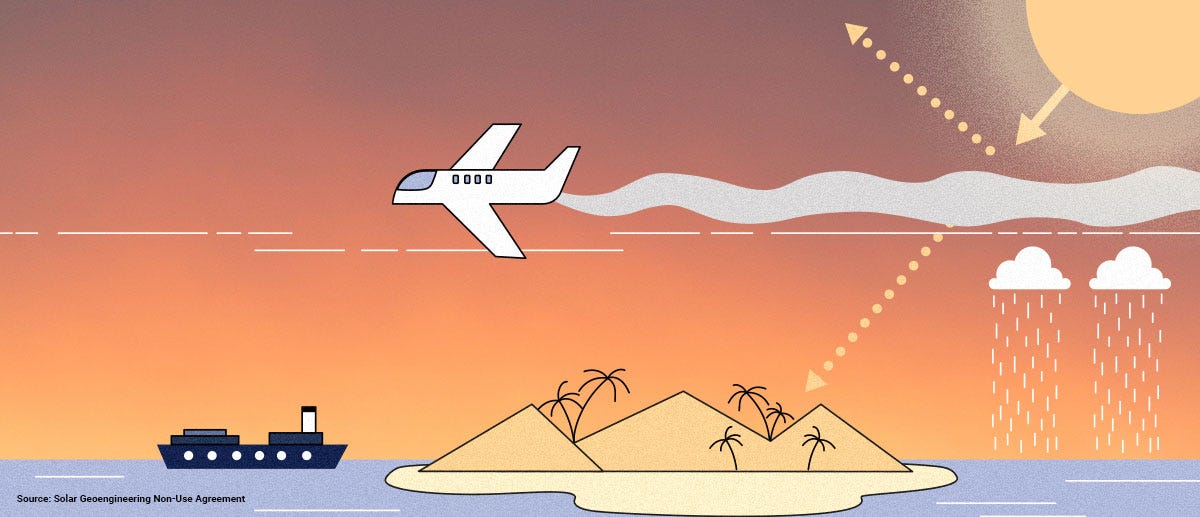
In 1991, Mount Pinatubo in the Philippines erupted with enough force to put 15 million tons of sulfur dioxide 50km into the atmosphere, with that dispersed SO2 reflecting an appreciable % of sunlight back into space. Short version: the effect was to cool Earth’s temperature by 0.6°C for two years.
What if we did that on purpose? What would happen if we did?
For 20 years, that question has been whispered in dark corners of the climate science and startup world, and features prominently in any decent science fiction writer’s imaginings of what humans might do if we reached this point. [spoiler alerts] Apple TV’s Extrapolations features it as a dramatic device, Kim Stanley Robinson’s Ministry for the Future imagines a climate-ravaged India desperately trying it in 2025, and it’s the central plot of Neal Stephenson’s Termination Shock, where a startup billionaire in Texas just starts doing it with a huge gun called Pina2bo.
So what’s the wicked problem?
Wicked Problems have particular characteristics. Problems without a right/wrong yes/no solution - only better vs worse, tamed rather than fixed. Uncertainty means you can’t know for sure the effects of any course of action before you take it - and there’s no CTRL-Z once you do it.
Geoengineering/solar radiation management is about as pure an example of an extreme response to a wicked problem as you can get.
There are some large-scale proper sci-fi ideas in the field - like, park a sun shade the size of Brazil but one molecule thick at the Lagrange point between the Earth and the Sun. As the RAND Corporation asked: “Why not space mirrors?” Another would be to paint every building roof white to increase albedo. Another would be to spray the Arctic and Antarctic with reflective particles to simulate ice.
DIYers Are At It
But the thing about doing a Pino2bo is that it’s cheap. So cheap that some DIYers are already doing it, as the FT reports:
On a Tuesday in August, Luke Iseman drove two hours east of Oakland in drought-stricken California to a remote spot where he launched a handful of balloons filled with sulphur dioxide and helium high into the sky.
From there, he used GPS to try to track the balloons as they rose into the stratosphere, the layer of Earth’s atmosphere that begins about 12km high and contains the ozone layer that protects the planet from solar radiation. Once there, they would burst and release the gas. Iseman’s start-up, Make Sunsets, is piloting small-scale stratospheric aerosol injections: the sulphur dioxide released by the balloons oxidises to form an aerosol, or fine mist, of sulphate particles that deflect some of the sun’s radiation.
So far it has launched 28, each the size of a small weather balloon. “The company’s mission is to cool the Earth as quickly as we safely can,” he says.
Make Sunsets has nearly $1m in VC funding from the Y-Combinator alum group Pioneer Fund and Boost VC. They’re just the one people have been reporting on since last year. There are plenty of others.
In the UK, Andrew Lockley - formerly with University College London and now an independent researcher - conducted a similar experiment last year in the UK, as reported by James Temple in MIT Technology Review.
The UK effort was not a test of or experiment in geoengineering itself. Rather, the stated goal was to evaluate a low-cost, controllable, recoverable balloon system, according to details obtained by MIT Technology Review. Such a system could be used for small-scale geoengineering research efforts, or perhaps for an eventual distributed geoengineering deployment involving numerous balloons.
The “Stratospheric Aerosol Transport and Nucleation,” or SATAN, balloon systems were made from stock and hobbyist components, with hardware costs that ran less than $1,000.
SATAN. Hooo boy.
What Could Go Wrong?
While cooling the planet sounds like a no-brainer, there’s no shortage of ways it could go wrong. As in, what if it interrupts the monsoon rainfall patterns, causing crop failures, famine, drought, pestilence? All the fun parts of the Bible, basically.
The FT quotes David Keith from the University of Chicago (also founder of Carbon Engineering - the carbon dioxide removal firm Occidental just acquired for $1.1 Billion) and Aarti Gupta of Wageningen University in the Netherlands:
“If we deliver sulphuric acid to the stratosphere in a jet aircraft, which we know we can build, and you did it enough to reflect half a per cent of sunlight, then the Earth would cool,” he says. “That’s not to say that it’s a good idea.”
There are uncertainties, Keith adds, over how much the sulphur dioxide might damage the ozone layer or human health, and whether it would influence extreme weather events. Scientists have, for example, looked at models that suggest aerosols released in the northern hemisphere could cause severe droughts in sub-Saharan Africa.
Gupta argues that there are “things we cannot know through small scale experiments . . . we’re looking for a planetary scale effect, so we need planetary scale experiments”. “In essence this is an untestable technology, because to test it would be to deploy it,” she concludes.
Termination Shock
The real problem is, once you start, it’s hard to know when you’d stop. If after years of cooling, the process is stopped, you’ll see the kind of unprecedented rapid warming that could see runaway global heating of multiple degrees all at once.
But because it’s so cheap, and there are people already doing a DIY version, who could stop it?
There have been discussions about trying to reach an international agreement to ban it - and the plots of the novels and TV shows above hinge on states or non-state actors trying to help or hinder a scaled version of the experiment.
In fact, in 2019 Switzerland introduced a resolution to do just that at the UN Environment Assembly. But it was vetoed. Can you guess? Yup. The US and Saudi Arabia objected, causing the Swiss to withdraw the proposal.
The FT posits the idea that what if Vladimir Putin decided to try this. But I’d be willing to guess an earlier version of the piece mentioned a G20 leader who seems far more likely to give it a whirl - Saudi Crown Prince Mohammed bin Salman.
In fact, NEOM - the futuristic city being built in Saudi’s northwest - features in Neal Stephenson’s Termination Shock novel. It’s not unimaginable that right now, sitting somewhere on MBS’ desk, is a proposal to do just that - a fleet of 1000 planes dumping SO2 into the air, flying year round, at a cost of a mere “tens of billions” per year. In fact it seems far less plausible that this hasn’t been a live discussion.
It’s been on the radar of Western policy thinkers for a long time. Even the UK’s innovation strategy discusses it.
And as the super-smart Michael Campos at Energy Impact Partners noted just yesterday - in fact, we just stopped a geoengineering experiment when maritime shipping abated all the SO2 they’d been pumping into the air for decades. Shutting that off seems to have actually increased, a tiny but measurable bit, the amount of sunlight reaching the Earth’s surface. Writing personally:
We essentially did a small termination shock to ourselves — conceding an extra 0.1-1 Watt per square meter in shipping lanes — and it didn’t result in catastrophe. What if we tried doing the opposite, but in a more responsible way that doesn’t have the poisonous effects of sulfur dioxide? With the usual caveat that climate science is complicated: seems bullish for marine cloud brightening.
The moral, economic, and strategic issues raised by a state actor going it alone on geoengineering are absolutely head-spinning. That’s even before you consider the moral horror of an energy industry that could use it to license continued fossil use.
But in the weeks leading up to COP28 in Dubai, with 1.5 C looking unlikely, you can expect today’s FT piece to kick this issue into a whole other level of discussion.
Desperate people do desperate things.
End of History
Neal Stephenson and Francis Fukuyama discuss Termination Shock.
Pursued by a Bear
Sifted’s Alexandra Bacon spoke to four climate tech investors for their picks of 15 climate tech companies to watch. In a nice touch, the investors - Tim Schumacher at World Fund, Tove Larsson at Norrsken, Jan Christoph Gras at Planet A, and Ellen Smeele at SET Ventures - weren't allowed to choose one of their own portcos.
Shoutouts to the UK players who made the cut
EV charging software player EV.Energy, boasting of VW, Siemens and National Grid as customers, backers including Matthias Dill at Energy Impact Partners, Bobby Kandaswamy at National Grid Partners, and Future Energy Ventures
Heat-pump software player Skoon, led by London-based CEO Aadil Qureshi, offers homeowners analytics to decarbonise their house
Thanks
That was a long one. If you’ve read this far, you hopefully found something worth your time. We’re glad you’re here. Why not share it with some friends who might get some value out of it. If you really like them, maybe give them a gift sub to start the autumn season.
Because Winter is Coming. And soon there will be a paywall for some of this goodness. Mwahahaha.
I can say from personal experience that when I worked on a project that suddenly removed all references to the 1.5 target, it was like hearing that a good friend had died. I’m not over it. And I think about this stuff for a living.